
Today’s Sermon focus
The identity of Jesus may confuse us but it matters.
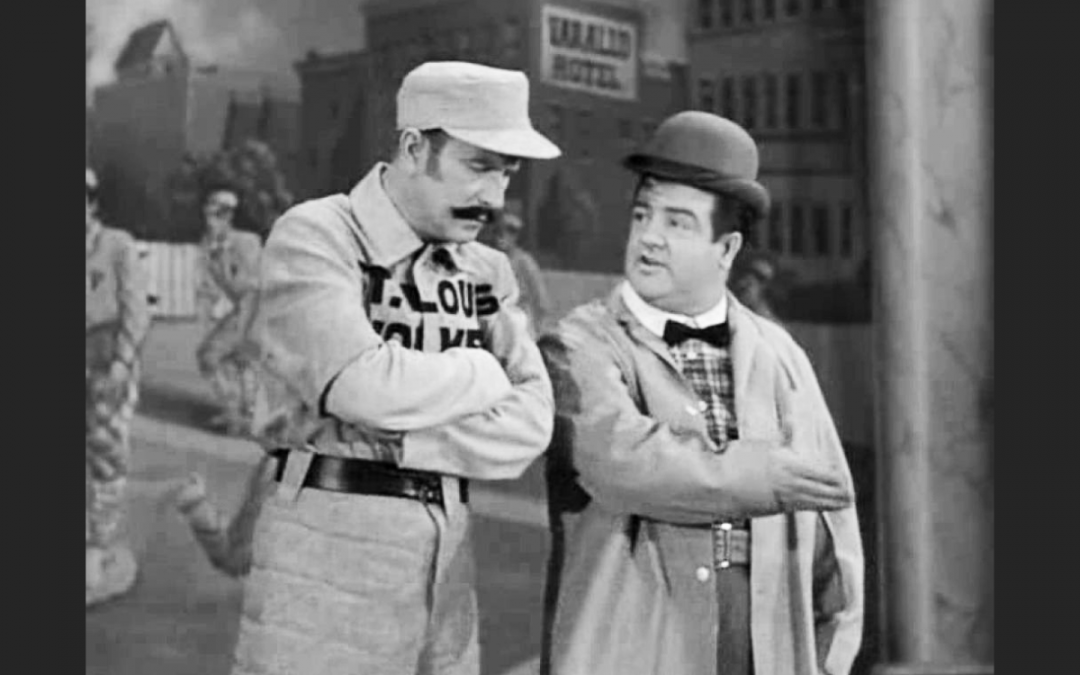
When is the last time you watched the Abbott and Costello skit, Who’s on First? I just watched it again this week and it’s even more funny than I remember. Do you remember this skit? There’s two guys talking about a favorite baseball team and the players’ names by their position. Thus, the question who’s on first? Well, the player’s nickname happens to be “Who.” What’s on second. I Don’t Know is on 3rd. There’s also Why, I Don’t Care, Today, and Tomorrow.
The hilarity of the skit is based on a play on language. Costello uses the words to simply mean what they mean, such as who, what, why, etc., while Abbott uses the same words primarily as the players nicknames. Afterall, people can be nicknamed anything, including Who, Why, or I Don’t Care, right? So both language-based realities are simultaneously true even as that tension is neither fully understood or acknowledged in the conversation. Predictably, this is monumentally frustrating to Costello’s character who simply wants to know who’s on first. As the audience, we get to just laugh because we are in on the “secret” that who is both the question and the answer at the same time. It’s comedic genius.
So, what does this have to do with Jesus?
The frustration of who being both question and answer in that classic skit is akin to the struggles that people had and have in clarifying Jesus’ identity. Now, Trinitarian Christians, such as us, profess that Jesus is both fully human and fully God. This is tricky for people. We tend to like it when things make sense. We like that 1+1=2. We like that it can be proven through complex mathematics, and we like it that we can also see it with our eyes and know it with our hands.
Not so with Jesus. From the very beginning, Jesus’ early followers struggled to understand who he was. Jesus would ask his disciples, “Who do people say I am? Who do you say that I am?” The answers would be Elijah or Moses or a prophet. Even when they’d answer, “You are the Messiah,” the disciples weren’t necessarily thinking God. They were expecting a military leader and a prophet, either of which would be human.
So, this scene with Thomas is important in part because he is the first disciple to declare that Jesus is God. And he says this however after identifying Jesus by his wounds, by his marked human flesh. To Thomas, he was God, but he was known through his humanness.
In the early centuries of the Christian church, there was a lot of turmoil and questions about the identity of Jesus. There were different sects of the church who believed in different things and multiple councils held across the church to come to a decision. Folks occasionally got so frustrated by these conversations that physical fights would break out. Why?
Think again about Who’s on First and how frustrated Costello got when Abbott just kept reiterating ‘Who’ is on first. So imagine the frustration of not agreeing on the “basic” question of who Jesus was. This seemingly basic question is till alive today and has implications for what Jesus’ life, death, and resurrection actually means.
In the early church, this idea that Jesus was both God and human was completely untenable for a lot of folks. For some, the idea that God died on the cross was unthinkable, so to them Jesus appeared to die but didn’t really. Or, there was a part of Jesus that was God, but wrapped in human wrapping so there was no contamination by Mary and only the human part died. There were a lot of ideas about how this worked.
There were also folks who considered Jesus to simply be a man or maybe even a special creature of God who hovered between man and God. Whatever and whoever they imagined Jesus to be, these folks held fast to their belief that Jesus was not God. This continues in non-Trinitarian churches.
Why does this matter? Or does it matter? Well, let’s imagine if Jesus was only God and his being didn’t really touch the grit and messiness of life and death, what would our relationship be with him then? For one, we may not trust that Christ really understands us. We might think there really are pockets of our experience that God in all of God’s glory couldn’t understand. Could God understand powerlessness without becoming powerless? Could God really understand fear, grief, and abandonment? Could God understand what it’s like to need to be challenged and to learn from it? Or how could God know what it feels like when our very human bodies get flooded with stress hormones, like adrenaline and cortisol that drive our heart beats and blood pressure out of control, and somehow we are supposed to maintain our calm?
Without Jesus’ identity of being fully human, could we really trust God’s compassion? If Jesus was only God, his relationship with our suffering might be more sympathy than compassion. He might say, “Wow, that looks hard over there but keep up the good work!” However, we know that Jesus knows the agonies and joys of being limited and human. He is in it with us and he chose that path out of love for us. The compassion of God is most alive in our lives because of Jesus’ humanness.
On the other hand, if Jesus were just human or a “creature of God” who is perhaps fancier than us as some folks thought, but still not God, how would that change things? Perhaps it would make us not particularly trusting of Jesus’ assurances of our forgiveness and redemption. With all love and respect for our friends and family, if our fellow humans tell us that we are whole and complete and beautiful in our imperfections, we might say thanks, but quietly disregard them. After all, they are just as human as we are. What do they really know? This reminds me of when my mom would say folks were “just jealous” when I’d have a squabble with someone. Well, of course I didn’t believe her. How could she possibly know that? Who was I to be jealous of? Now that I’m older and I understand a bit more about how much moms actually do know, I should have believed her more than I did. However, that’s still different than God being here with us, in our relationships, in our world, in our hearts and minds, understanding us from the insides out and declaring us beloved and forgiven. The incarnation of God in Jesus and in us together as the body of Christ is very different than God being over there and us over here.
Because Jesus was human and God, his teaching and his life take on massive significance. If Jesus wasn’t God, but just a special man, his obedience and willingness to die would mean less than it does. For sure, his death would have been honorable however you view it. But if this is God, truly God choosing death and non-violence as the path of creating new life and justice for all people, that is a dramatically different meaning, is it not? It’s something to ponder, to journal about, or perhaps a good dinner conversation to play out the thought experiments of what it would mean to you if Jesus were only God or only human, because there’s implications beyond what I’ve named here. Jesus being both human and God is mind-bending. It is not a reality that is easily understood, but that identity has ramifications and power.
Jesus’ identity as God and man was “decided” at the Council of Chalcedon in 451AD. The Chalcedon Formula defining Jesus identity is briefly stated as this: “We all teach harmoniously [that he is] the same perfect in godhead, the same perfect in manhood, truly God and truly man, the same of a reasonable soul and body; same in being with the Father in godhead, and the same sharing of essence with us in manhood… acknowledged in two natures without confusion, without change, without division, without separation.”[ii]
This is a serious intellectual rabbit hole you could go down, if you so chose. Very smart people have landed in different camps on the question. But then we hear Thomas’ testimony, my Lord and my God, as his response to the resurrected Jesus. His immediate and heart-felt response to his experience was that both were true, regardless of how intellectually uncomfortable it may be to wrestle with later. But in the moment, in response to this miracle, it was what made sense to Thomas.
The Easter season is a time of wrestling with the identity of Christ. Just because the larger church body decided on this question in 451, that doesn’t mean you can’t ask the same questions. It took folks 420ish years to get to that conclusion. You can wrestle with it, get in there and maybe even get a little frustrated like Costello, and go down those pathways with wonder and curiosity. What does it mean that Jesus is God and human? That God died? That God allowed this human violence against God’s own self? That God chose and chooses to be inside our gritty lives and bodies? That God chose the cross as the path of power and new life? You could go big with this spiritual rabbit hole. You could get a PhD, write books, get on the lecture circuit because there is a mystery here to explore further. Or you can keep it a bit more simple, like Thomas, and proclaim in faith and gratitude, “My Lord and my God.” But know this, that Jesus’ life, death, and resurrection has made all the difference and continues to do so.
AMEN
[ii] https://en.wikipedia.org/wiki/Council_of_Chalcedon
John 20:19-31
19 When it was evening on that day, the first day of the week, and the doors were locked where the disciples were, for fear of the Jews, Jesus came and stood among them and said, “Peace be with you.” 20 After he said this, he showed them his hands and his side. Then the disciples rejoiced when they saw the Lord. 21 Jesus said to them again, “Peace be with you. As the Father has sent me, so I send you.” 22 When he had said this, he breathed on them and said to them, “Receive the Holy Spirit. 23 If you forgive the sins of any, they are forgiven them; if you retain the sins of any, they are retained.”
24 But Thomas (who was called the Twin[a]), one of the twelve, was not with them when Jesus came. 25 So the other disciples told him, “We have seen the Lord.” But he said to them, “Unless I see the mark of the nails in his hands and put my finger in the mark of the nails and my hand in his side, I will not believe.”
26 A week later his disciples were again in the house, and Thomas was with them. Although the doors were shut, Jesus came and stood among them and said, “Peace be with you.” 27 Then he said to Thomas, “Put your finger here and see my hands. Reach out your hand and put it in my side. Do not doubt but believe.” 28 Thomas answered him, “My Lord and my God!” 29 Jesus said to him, “Have you believed because you have seen me? Blessed are those who have not seen and yet have come to believe.”
30 Now Jesus did many other signs in the presence of his disciples that are not written in this book. 31 But these are written so that you may continue[b] to believe that Jesus is the Messiah,[c] the Son of God, and that through believing you may have life in his name.
Service Recording
Gospel and Sermon at 24:20
Join Our Email List
We email prayer requests to the community, along with worship bulletins for online worship, updates on special events, and the monthly newsletter. In general, you can expect about 3-4 emails a week from Celebration Lutheran.